How to use the ladder
- Find the hottest point of the run, not the oven or heater setting. A lead wire next to a heating element, inside an enclosure or on a motor housing can sit well above the room or process temperature.
- Add the wire's own heating. The rating is the conductor temperature, and current raises it above the surrounding air. Heavily loaded or bundled wires run hotter.
- Pick the first rung at or above that figure, with headroom. If the hottest point is close to a rung, go one rung up. Then check voltage, size and flexibility on the product page.
The full ladder
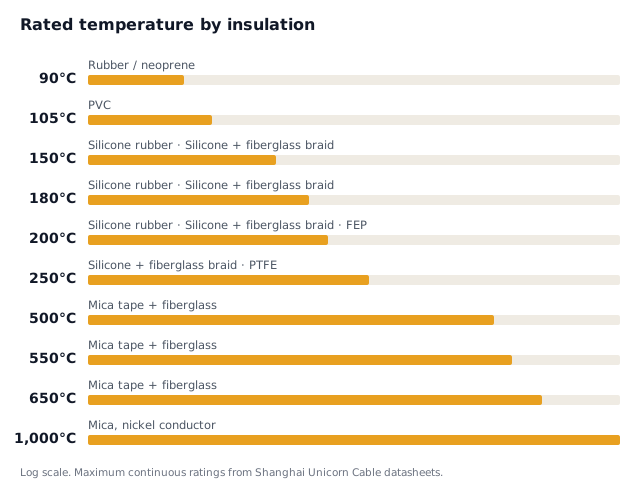
Each product links to its page, where the datasheet PDF has sizes, voltage and construction.
| Rating | Insulation | Product | Voltage |
|---|---|---|---|
| 90°C | Rubber / neoprene | Crane Pendant Control CableSW-PENDANT-12C-100 | 600V |
| 105°C | PVC | Type JX Compensating Lead WireSW-JX-24-1000 | 200V |
| PVC | Type KX Compensating Lead WireSW-KX-24-1000 | 200V | |
| PVC | Type TX Compensating Lead WireSW-TX-24-1000 | 200V | |
| 150°C | Silicone rubber | Silicone Wire UL AWM 3132SW-UL3132-16-500 | 300V |
| Silicone + fiberglass braid | Fiberglass Silicone Wire UL3068SW-UL3068-14-500 | 300V | |
| Silicone + fiberglass braid | Fiberglass Silicone Wire UL3069SW-UL3069-16-500 | 600V | |
| 180°C | Silicone rubber | Multiple Cores Cable YGZ Heavy DutySW-YGZ-14-4C-500 | 450V/750V |
| Silicone rubber | Multiple Cores Cable YGZP SiliconeSW-YGZP-16-3C-500 | 450V/750V | |
| Silicone rubber | Silicone Rubber Wire AGG TypeSW-AGG-20-500 | 500V | |
| Silicone rubber | Silicone Wire JG Type FlexibleSW-JG-18-500 | 500V | |
| Silicone rubber | Silicone Wire JHXG 1140V High VoltageSW-JHXG-16-1140V | 1140V | |
| Silicone + fiberglass braid | Silicone Wire JGG Fiberglass BraidedSW-JGG-18-500 | 500V | |
| 200°C | Silicone rubber | Silicone Rubber Wire AGR TypeSW-AGR-18-500 | 600V |
| Silicone rubber | Silicone Wire UL AWM 3135SW-UL3135-14-500 | 600V | |
| Silicone rubber | Silicone Wire UL3512 Fine GaugeSW-UL3512-22-500 | 600V | |
| Silicone + fiberglass braid | Fiberglass Silicone Wire AGRP TypeSW-AGRP-16-500 | 600V | |
| Silicone + fiberglass braid | Fiberglass Silicone Wire UL AWM 3122SW-AWM3122-20-500 | 600V | |
| Silicone + fiberglass braid | Fiberglass Silicone Wire UL AWM 3133SW-AWM3133-18-500 | 600V | |
| FEP | Fluorine Plastic Hook-Up Wire UL1901SW-UL1901-20-500 | 300V | |
| FEP | Fluorine Plastic Wire FF46-1 TypeSW-FF46-1-18-500 | 600V | |
| FEP | Fluorine Plastic Wire FF46-2 TypeSW-FF46-2-16-500 | 600V | |
| FEP | Multiple Cores Cable FF/FFRP-3SW-FFRP3-20-3C-500 | 300V | |
| FEP | Multiple Cores Cable KFF/KFFRP-3 ShieldedSW-KFFRP3-18-4C-500 | 300V | |
| 250°C | Silicone + fiberglass braid | Fiberglass Braided Silicone Wire IEC 60245SW-60245-18-500 | 450V/750V |
| PTFE | PTFE Wire AF250 High TemperatureSW-AF250-18-500 | 250V | |
| PTFE | PTFE Wire AFR250 Flexible High TemperatureSW-AFR250-18-500 | 250V | |
| 500°C | Mica tape + fiberglass | Fire Resistant Mica Wire GN500SW-GN500-18-500 | 500V |
| 550°C | Mica tape + fiberglass | Fire Resistant Mica Wire GN800SW-GN800-16-500 | 800V |
| 650°C | Mica tape + fiberglass | Fire Resistant Mica Wire GN1000SW-GN1000-14-500 | 1000V |
| 1,000°C | Mica, nickel conductor | Pure Nickel Mica Wire - Resistant to 1000°CSW-NIMICA-1000C | 600V |
What sets each step
- PVC and rubber (up to about 105°C). Cheap and tough, but they soften with heat. In our range they cover crane pendant cable and thermocouple compensating lead wire.
- Silicone rubber (150–200°C). Stays flexible from very low temperatures up to its rating, which is why it is the default for appliance, motor and lighting leads.
- Silicone with a fiberglass braid (150–250°C). The braid adds abrasion and cut-through resistance for runs that rub on metal edges. The rating comes from the whole construction, so it varies by product.
- FEP (200°C) and PTFE (250°C). Fluoropolymers resist oils, fuels and most chemicals, and allow thin walls. See PTFE vs FEP wire.
- Mica tape (500–650°C). The GN series wraps the conductor in mica, a mineral that does not burn. It is also built to keep circuits working in a fire; see fire-resistant cable standards.
- Mica with a nickel conductor (1,000°C). At this level copper oxidizes quickly, so the conductor is pure nickel.
Heating cable and tracing band are not on the ladder: they produce heat, and their figures are maintain and exposure temperatures. See how to select heating cable.
Frequently Asked Questions
What does a wire's temperature rating mean?
It is the highest temperature the conductor can run at continuously without damaging the insulation. That includes the heat the wire makes itself from the current it carries, so a wire in a 180°C ambient that also carries current runs hotter than 180°C.
Can I run 200°C wire a little above 200°C?
Don't plan for it. The rating is the continuous limit, and running above it shortens insulation life. If the hottest point of the run gets close to a rung, choose the next rung up.
Does a fiberglass braid raise the temperature rating?
Not by itself. The braid mainly adds abrasion and cut-through resistance. In our range, silicone wire with a fiberglass braid is rated anywhere from 150°C to 250°C depending on the construction, so check the rating of the exact product.
Which wire do I use above 650°C?
In our range, the only wire rated above 650°C is the pure nickel mica wire, rated 1,000°C. Copper oxidizes quickly at those temperatures, so the hottest constructions use nickel conductors.
Send your spec, get a quote within 24 hours
Tell us the hottest temperature on the run, the voltage and the size. We'll recommend the rung and send pricing.