
High Temperature Constant Power Tracing Band
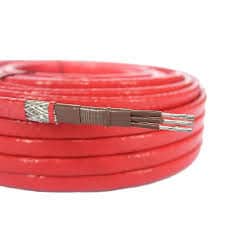
RDP2 series constant-wattage tracing band for precise process pipe heat tracing.
What Is Constant Power Tracing Band?
Constant power tracing band is a parallel-circuit electric heat-tracing cable that maintains a fixed wattage output per meter regardless of the pipe temperature it's wrapped around -- unlike self-regulating heat trace, whose output varies with ambient temperature. That constant, predictable output is specifically valuable for process piping that needs to be held at a precise temperature for viscosity or freeze-protection reasons: molten sulfur lines, high-viscosity fluid transport, and other process heating applications where the heat trace needs to deliver a known, unchanging wattage rather than an ambient-responsive one.
Looking for lower-wattage heating cable instead? See our full Heating Cable catalog.
Selecting the Right Wattage and Construction
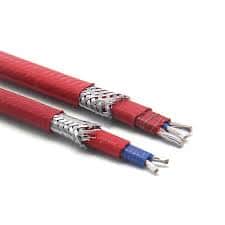
The two constructions in this family differ by power density: RDP2-J3 delivers 35 W/m, RDP2-J4 delivers 50 W/m. Selection comes down to the actual heat-loss calculation for the pipe being traced -- pipe diameter, insulation thickness, ambient temperature, and target maintenance temperature all factor into which wattage is sufficient. Under-specifying wattage leaves the pipe unable to reach or hold target temperature in cold ambient conditions; over-specifying wastes energy and adds unnecessary cost, so this is a calculation worth doing properly rather than defaulting to the higher-wattage option out of caution.
Both constructions use an FEP fluoropolymer outer jacket over a tinned-copper braid shield, chosen specifically for chemical resistance and mechanical durability in outdoor, insulated pipe-tracing installations that may see years of continuous service without inspection access. Installation follows standard heat-tracing practice: the band is run parallel to the pipe under thermal insulation and jacketing, with a control system regulating overall circuit power rather than the cable itself self-limiting output.
35-50 W/m
Two power densities (RDP2-J3, RDP2-J4) to match pipe heat-loss requirements precisely.
Up to 180°C
FEP fluoropolymer outer jacket rated for sustained process-piping temperature maintenance.
Constant Output
Delivers fixed wattage regardless of pipe temperature -- unlike self-regulating heat trace.
High Temperature Constant Power Tracing Band Products
2 products in this family
Applications
Process Piping
- Molten sulfur lines
- High-viscosity fluid transport
- Chemical process piping
Industrial Heat Tracing
- Precision temperature maintenance
- Outdoor insulated pipe systems
Need a Custom Wattage or Length?
Our engineering team can match conductor stranding, wall thickness, and color coding to your exact requirement.
High Temperature Constant Power Tracing Band FAQ
What's the difference between constant power tracing band and self-regulating heat trace?
Constant power tracing band delivers a fixed wattage per meter regardless of pipe temperature. Self-regulating heat trace automatically reduces output as ambient temperature rises. Constant power is specified when a precise, unchanging heat input is required, such as viscosity control on process piping.
How do I choose between RDP2-J3 (35W/m) and RDP2-J4 (50W/m)?
Base the choice on a heat-loss calculation for your specific pipe: diameter, insulation thickness, ambient temperature, and target maintenance temperature. Under-sizing wattage risks the pipe not reaching target temperature in cold conditions; over-sizing wastes energy.
What temperature range is this rated for?
Up to 180°C process maintenance temperature, with an FEP fluoropolymer outer jacket chosen for chemical resistance and durability in outdoor, insulated pipe installations.
Is this different from the constant-wattage heating cable on your Heating Cable page?
Yes -- both are constant-wattage heat-tracing technology, but the RDP2 tracing band constructions here are a higher-power-density, process-piping-focused product line. Our Heating Cable page covers a broader range of heating cable constructions including lower-wattage general-purpose options.