
The set point is not the wire temperature
The thermostat measures the air in the cavity. The lead wire never sits in that air: it is attached to the heating element, routed behind insulation and through gaps in sheet metal. Each of those places can be hotter or cooler than the set point.
- Hotter: at the element terminal, where heat conducts straight into the wire; inside insulated walls and enclosures with no airflow; and next to radiant surfaces such as burners, muffles and glowing elements.
- Cooler: once the wire is outside the insulation and in moving air, such as in a ventilated control compartment.
- On top of that: the current in the wire heats it further. A wire's temperature rating is its conductor temperature, so the load counts.
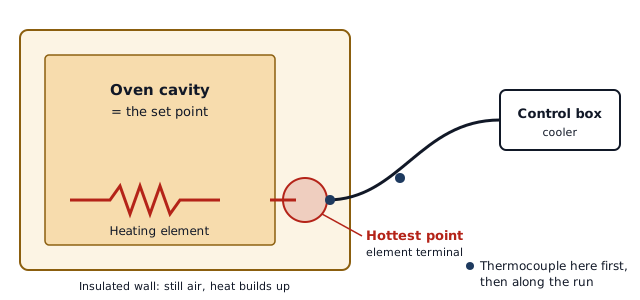
How to measure it
- Use a contact thermocouple (type K is the usual choice) taped or clamped to the wire insulation, not an infrared gun. Put the first one where the wire leaves the element terminal, then add more along the run, especially where it passes through walls or sits in still air.
- Run the worst case: the highest set point, full load, all elements on, doors and covers closed, and the warmest room the unit will see.
- Wait for steady state. Keep the unit running until the readings stop rising. Terminal areas heat up more slowly than the cavity.
- Take the highest reading from any point on the run. That is the number you choose wire for.
If you are wiring the thermocouples themselves, use matching extension or compensating wire for the run back to the meter; see the thermocouple extension wire guide.
From your reading to a wire
Find your highest measured temperature in the left column. The table gives the lowest rating in our range that covers it. If your reading is close to the top of a band, use the next row down.
| Hottest measured point | Wire rating | Insulation | Example product |
|---|---|---|---|
| up to 150°C | 150°C | Silicone rubber, Silicone + fiberglass braid | Silicone Wire UL AWM 3132 |
| 151°C–180°C | 180°C | Silicone rubber, Silicone + fiberglass braid | Multiple Cores Cable YGZ Heavy Duty |
| 181°C–200°C | 200°C | Silicone rubber, Silicone + fiberglass braid, FEP | Silicone Rubber Wire AGR Type |
| 201°C–250°C | 250°C | Silicone + fiberglass braid, PTFE | Fiberglass Braided Silicone Wire IEC 60245 |
| 251°C–500°C | 500°C | Mica tape + fiberglass | Fire Resistant Mica Wire GN500 |
| 501°C–550°C | 550°C | Mica tape + fiberglass | Fire Resistant Mica Wire GN800 |
| 551°C–650°C | 650°C | Mica tape + fiberglass | Fire Resistant Mica Wire GN1000 |
| 651°C–1,000°C | 1,000°C | Mica, nickel conductor | Pure Nickel Mica Wire - Resistant to 1000°C |
Every product at each rating is on the lead wire temperature ladder (PDF).
Ovens, heaters and furnaces: what usually decides it
- Ovens and dryers. The terminal area behind the back panel is usually the hot spot. Silicone rubber lead wire covers most of this range and stays flexible for assembly; add a fiberglass braid where the wire rubs on sheet-metal edges.
- Heaters and heating elements. The cold end of the element and its terminal decide the rating. Keep the lead wire short through the hot zone and make the changeover to ordinary wire outside it.
- Kilns and furnaces. Inside or close to the hot face, polymer insulations are not enough; this is mica territory, and above the mica tape ratings the nickel-conductor mica wire. Fluoropolymers (FEP, PTFE) help where oils or chemicals are also present; see PTFE vs FEP.
Whatever the wire, the terminal or crimp on the end has to be rated for the same temperature. A high-temperature wire on an ordinary terminal fails at the terminal.
Frequently Asked Questions
Why does the wire at the heater terminal run hotter than the oven setting?
The element terminal is attached to the hottest part of the system, and heat conducts along it into the wire. Terminal areas also tend to sit in still air behind panels or insulation, so they cannot shed heat. The thermostat measures the cavity air, not the terminal.
Can I check the wire temperature with an infrared thermometer?
Not reliably. On a thin wire the infrared spot is usually larger than the wire, so it averages in the background, and shiny or braided surfaces read wrong because of emissivity. A thermocouple taped or clamped to the insulation gives a far more trustworthy reading.
Does the whole run need high-temperature wire?
Only the part that sits in the hot zone. Many designs use high-temperature lead wire from the element to a terminal block outside the hot zone, then ordinary wire from there. The connection at the changeover has to be rated for the temperature it sees too.
What if my reading falls right on a rating?
Go one rating up. The rating is a continuous limit, and real units run hotter on a hot day, at high line voltage or as insulation and seals age.
Send your spec, get a quote within 24 hours
Send the hottest temperature you measured, the voltage and the size. We'll recommend the wire and send pricing.