Sleeving protects the wire; it doesn't change its rating
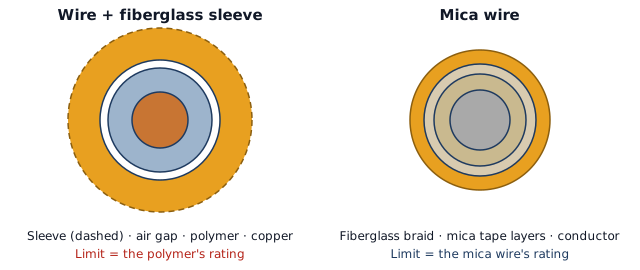
Fiberglass sleeving is a woven tube. Over a silicone or fluoropolymer wire it blocks sparks, slag and abrasion, and it slows the wire's response to a short burst of radiant heat. What it cannot do is keep the wire cool in a place that stays hot: given time, the inside of the sleeve reaches almost the same temperature as the outside, and the insulation underneath fails at its normal limit.
So a 200°C silicone wire in sleeving is still a 200°C wire. In a 500°C furnace zone it will char, however good the sleeve.
Mica wire: the insulation itself is mineral
Mica is a mineral that does not burn or melt at furnace temperatures. Mica wire wraps the conductor in layers of mica tape, usually with a fiberglass braid over it to hold the tape and resist abrasion. Because the insulation is mineral, the rating applies to the wire itself, with nothing polymer underneath to fail first.
Our mica wire ratings, from the catalog:
| Rating | Product | Conductor | Voltage |
|---|---|---|---|
| 500°C | Fire Resistant Mica Wire GN500 | Nickel-Plated Copper Stranded | 500V |
| 550°C | Fire Resistant Mica Wire GN800 | Nickel-Plated Copper Stranded | 800V |
| 650°C | Fire Resistant Mica Wire GN1000 | Nickel-Plated Copper High-Strand Count | 1000V |
| 1,000°C | Pure Nickel Mica Wire - Resistant to 1000°C | High Purity Pure Nickel (Ni≥99.96%) | 600V |
What changes at 1,000°C: the conductor
At the top of the range the insulation is not the only problem. Copper oxidizes quickly at these temperatures, so the hottest constructions use a nickel conductor. Nickel conducts roughly a quarter as well as copper, so for the same size it carries less current and drops more voltage. Keep the nickel section short, inside the hot zone, and change over to copper-conductor wire outside it.
Where fiberglass sleeving still makes sense
- Over wire that is already rated for the temperature, to add abrasion and spark protection.
- Where a wire passes briefly near a hot surface but does not sit in the hot zone.
- To bundle and tidy several leads at the cool end of the run.
A practical layout for kilns and furnaces
- Mica wire from the element terminal through the hot face and wall.
- A terminal block rated for the temperature at that point, outside the hottest zone.
- Silicone or fluoropolymer lead wire from there to the controls, chosen from the lead wire temperature ladder.
Not sure how hot each section gets? Measure it first: see how hot does the wire actually get.
Frequently Asked Questions
Can fiberglass sleeving raise the temperature rating of silicone wire?
No. The sleeving shields the wire from abrasion, sparks and direct radiant heat, but the insulation underneath keeps its own rating. In a zone that stays hot, the inside of the sleeve heats up to nearly the same temperature, and the silicone fails at its usual limit.
Can I run bare wire inside fiberglass sleeving as the insulation?
It is not a rated insulation. Woven fiberglass is porous, so moisture, dust and conductive deposits get into it, and its insulating value drops. Use wire whose own insulation is rated for the temperature, such as mica wire.
Why does 1,000°C wire use a nickel conductor?
Copper oxidizes quickly at those temperatures and the conductor degrades. Nickel holds up far better. The trade-off is resistance: nickel conducts roughly a quarter as well as copper, so check voltage drop and current for the size you choose.
Is mica wire the same as fire-resistant cable?
Our GN series is both: mica tape insulation rated for continuous high temperature, and constructions tested to keep circuits working in a fire (IEC 60331, BS 6387). See the fire-resistant cable standards guide for what those tests mean.
More on fire testing: fire-resistant cable standards.
Send your spec, get a quote within 24 hours
Tell us the hot-zone temperature, the current and the run length. We'll recommend the mica wire and size.