
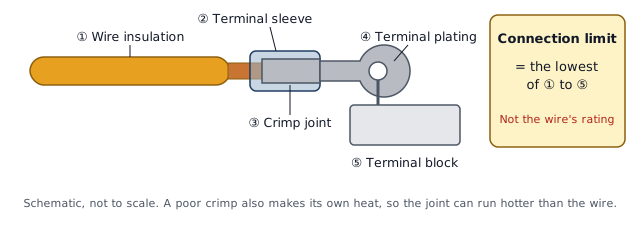
Why the joint runs hotter than the wire
A crimp or screw joint always has some contact resistance, and current through it makes heat right at the connection. In a hot zone that heat adds to the surroundings. Over time, heating and cooling loosen the joint and oxidize the contact surfaces, which raises the resistance, which makes more heat. That is why high-temperature failures so often start at a terminal while the wire beside it looks fine.
Check every part of the chain
| Part | What limits it | What to do |
|---|---|---|
| Terminal insulating sleeve | The plastic sleeve on a pre-insulated terminal is usually the lowest rating in the whole connection. | Use uninsulated terminals in the hot zone and cover them with sleeving rated for the temperature. |
| Plating | Tin melts at 232°C and softens well before that. | Above tin's range, use nickel-plated or solid nickel terminals, rated by their maker for the temperature. |
| Solder | Common solders melt between about 183°C (tin-lead) and 227°C (lead-free). | Don't solder joints that sit in the hot zone. Crimp, or weld at the highest temperatures. |
| Crimp joint | A loose or under-crimped joint has extra resistance, so it heats itself. | Match terminal, conductor size and tool; use the terminal maker's tooling and a pull test. |
| Terminal block or connector housing | The housing plastic has its own rating, often lower than the wire's. | Use ceramic blocks in the hot zone, or move the block to a cooler spot. |
Terminal and block ratings vary by maker and material, so take them from the terminal manufacturer's datasheet.
Terminating each wire type
- Silicone rubber wire. Silicone is soft and tears easily, so strip it without nicking the conductor and don't let the crimp barrel bite into the insulation. Support the wire near the terminal so vibration doesn't work the joint.
- Fiberglass-braided wire. Trim the braid cleanly and stop it fraying so loose glass fibers don't end up inside the crimp.
- FEP and PTFE wire. The insulation is slippery and hard, so use strippers made for fluoropolymers and check the strip length; the walls are thin and easy to over-strip.
- Mica wire. Mica tape and braid need care when stripping. Nickel conductors are harder than copper, so use terminals and crimp tooling intended for nickel.
Better still: move the joint
The most reliable high-temperature termination is one that isn't in the hot zone. Run the high-temperature lead wire out to a terminal block in cooler air, then change over to ordinary wire there. To find where that cooler spot is, measure it: see how hot does the wire actually get. For the wire itself, use the lead wire temperature ladder.
Frequently Asked Questions
Why does a connection fail before the wire?
Every part of the connection has its own temperature limit, and the joint itself makes heat if its resistance is high. Heat and thermal cycling loosen a joint and oxidize the contact surfaces, which raises resistance and makes it hotter still. That spiral is why failures start at terminals.
Can I use pre-insulated crimp terminals on 200°C silicone wire?
Only where the terminal stays cool enough for its sleeve. In the hot zone, use an uninsulated terminal and insulate it with sleeving rated for the temperature.
Is soldering OK for high-temperature wire?
Not in the hot zone. Common solders melt between about 183°C and 227°C and creep at lower temperatures under load. Crimp the joint instead.
How do I terminate fiberglass-braided or mica wire?
Strip the braid cleanly and stop it fraying, for example with a short sleeve or a high-temperature tie, so loose glass fibers don't get into the crimp. Make sure only bare conductor goes into the crimp barrel. For nickel-conductor wire, use terminals and tooling intended for nickel.
Send your spec, get a quote within 24 hours
Tell us the temperature at the terminal, the current and the size. We'll recommend the wire for that run.