
Why silicone and oil don't mix
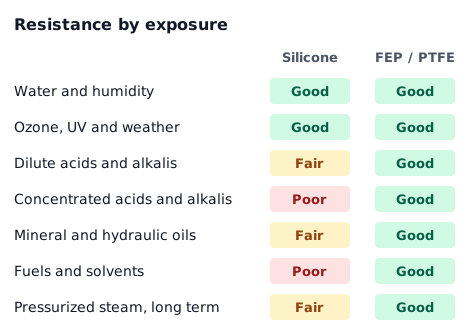
Silicone rubber is a loosely cross-linked elastomer. That open structure is what keeps it flexible from deep cold to its full temperature rating, and it is also why hydrocarbons get in: oils, fuels and many solvents are absorbed into the rubber, which swells, softens and loses strength. Heat speeds this up, so oil that a cold wire would tolerate can damage the same wire next to a hot motor.
Fluoropolymers work the other way. FEP and PTFE have very tightly bound carbon–fluorine chains that almost nothing dissolves into, which is why they are the standard insulation in chemical plants and around fuels.
When silicone is still the right wire
- Heat is the main problem and oil contact is occasional splashes that get cleaned off.
- The wire must stay flexible in the cold or bend tightly during assembly.
- It runs outdoors or in damp air: silicone shrugs off ozone, UV and humidity.
When to switch to FEP or PTFE
- Wiring inside gearboxes, hydraulic units, compressors or engines where it stays coated in oil.
- Anywhere near fuels, solvents, cleaning chemicals or acids.
- Long exposure to pressurized steam, such as in autoclaves and steam lines.
In our range FEP wire covers up to 200°C and PTFE wire up to 250°C. The full comparison is in PTFE vs FEP wire, and temperature limits for every wire we make are on the lead wire temperature ladder.
Don't count on the braid
A fiberglass braid over silicone is there for abrasion. It does nothing for chemical resistance and, because it is porous, can soak up oil and hold it against the insulation. Pick the insulation for the chemical and the braid for the mechanical wear.
Frequently Asked Questions
Is silicone wire oil-resistant?
Only moderately. Splashes of mineral or hydraulic oil that are wiped off are usually fine, but continuous contact makes silicone swell and soften, and fuels and solvents attack it faster. For wiring that stays wet with oil, fuel or solvent, use FEP or PTFE wire.
Does a fiberglass braid make silicone wire oil-resistant?
No. The braid adds abrasion resistance, but it is porous and can wick oil along the wire and hold it against the silicone. Choose the insulation for the chemical; choose the braid for abrasion.
Which is more chemical-resistant, FEP or PTFE?
Both are close to inert against almost all oils, fuels, solvents, acids and alkalis. The practical differences are temperature and flexibility: in our range FEP wire is rated 200°C and PTFE wire 250°C. See PTFE vs FEP wire for the full comparison.
How do I confirm a wire will survive my fluid?
Soak a sample in the actual fluid at the actual temperature for a few weeks and compare it with an unsoaked piece: look for swelling, softening, cracking and loss of flexibility. We send free samples for this kind of test.
More on silicone itself: silicone cable temperature guide.
Send your spec, get a quote within 24 hours
Tell us the temperature and what the wire will touch. We'll recommend silicone or fluoropolymer and send a free sample for your soak test.